MItakon 50mm f/-95 lens for E-Mount
I was fascinated by this lens. While the “gold standard” of fast primes is the Leica Noctilux (https://us.leica-camera.com/Photography/Leica-M/M-Lenses/Noctilux-M-50mm-f-0.95-ASPH), it’s price is eye-watering at over $10,000. Mitakon makes a similar spec’d lens for SONY E-mount for ~$900 so I bought one to give it a try. The reviews were clear that, at f/.95, the lens was “soft”, likey much softer than the Noctilux. On the other hand, the rendering at this aperture leads to a very “dreamy” image where only the point of focus is sharp and the rest is nicely blurred. I’m sure the quality of the bokeh is far better witht he Noctilux but, again, the price difference is extreme.
My first test with this lens was to see how it compared to a “known” lens - the SONY/Zeiss 55mm f/1.8. This is a sharp lens at all apertures so I thought I’s do a comparison with a resolution target.
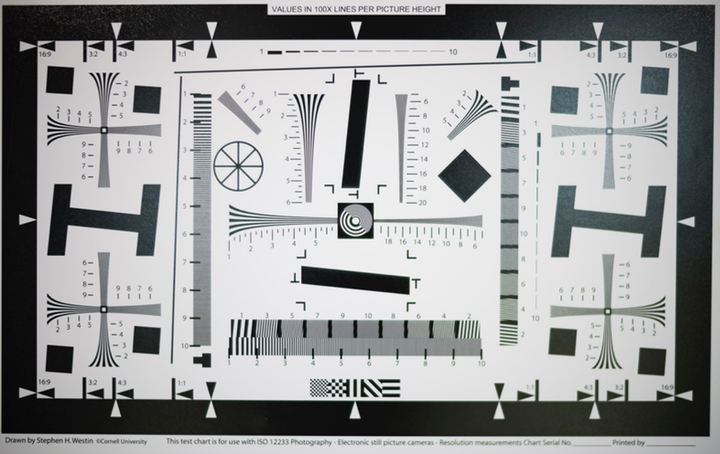
I positioned the camera to fill the frame with the target, which put it at ~2ft distance. I lit it with 2 LED panels positioned above and to the right and left of the target. It was a challenge to light the target evenly as you can see. Plus the rough texture of the target caused specular effects you will see in the magnified crops. Both cameras were set in manual exposure mode and manually focussed.
At this distance, the DOF for the Mitakon, at f/.95, is approx 0.3in.
Here’s a compariosn between the SONY/Zeiss at f/1.8 and the Mitakon at f/.95, cropped.
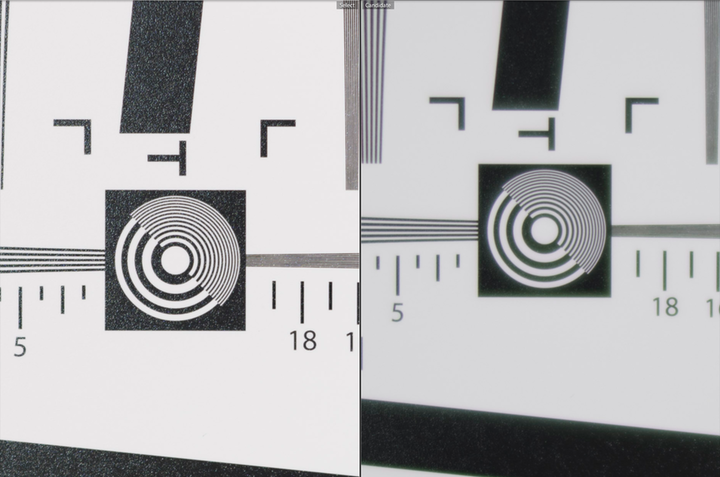
SONY/Zeiss on the left (f/1.8), Mitakon on the right (f/.95.
Clearly there is softness, but not extreme. Much of this softness was corrected with some minor adjustments in Lightroom as shown below.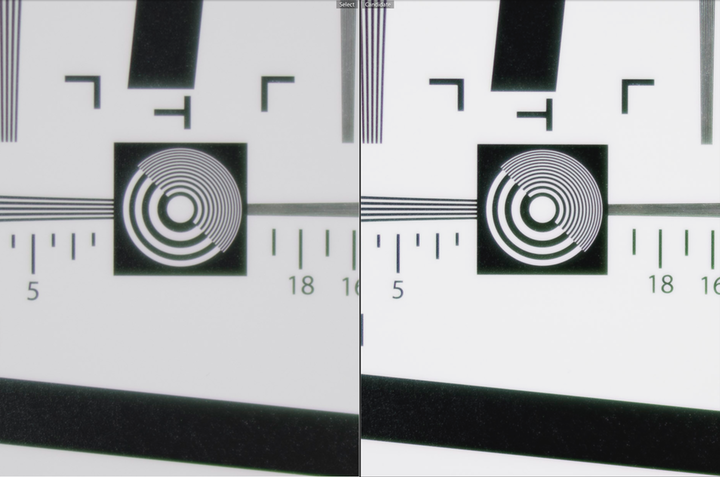
Both images are with the Mitakon @f/.95. The left image is uncorrected, the right image is the same file which has the following corrections applied:
Exposure - +.35
Contrast - +65 (this makes a big difference but may not need to be this much, depending on the subject)
Sharpening - 60/.7/70/20 (per Diglloyd)
Manual lens distortion correction - +5 - corrects mild barrel distortion
The image benefitted fro a small amount of “dehaze” adjustment to reduce the halos. - +13
While not so evident from the target images, there is also quite a bit of vignetting which can easily be corrected in Lightroom, if desired.
By the time we got to f/2, both lenses had similar center resolution, although the SONY/ZEISS retaind slightly better edge focus.
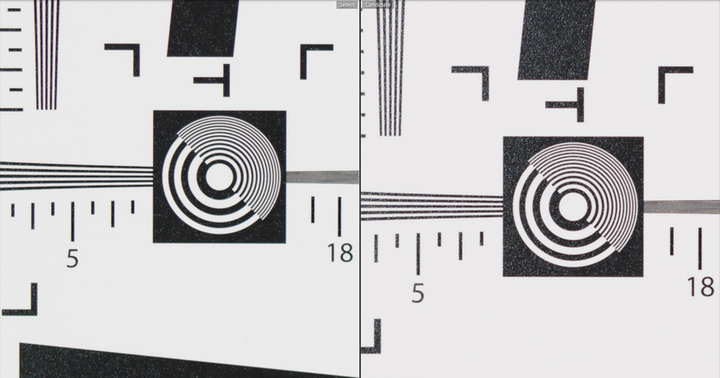
Mitakon is on the left, SONY/ZEISS is on the right. Both at f/2.0, uncorrected.
Both lenses had similar performance up to f/8, the limit to which I tested.
A note on manual focussing. At f/.95, focussing becomes quite challenging and critical. Focus peaking is essential and I had it set it to “high”. This was the only setting which allowed me to get the best guide for focus when fully magnified on the rear LCD/viewfinder.
I next tried some (pseudo) real world examples.
Below are presented (cropped) images at different apertures. All focussed on the eye.

F/.95
Corrected:
Exposure: +.4
Contrast: +25
Sharpness: 60/.7/70/20
Dehaze: +13

f/1.4 - uncorrected

f/5.6 - uncorrected.
More cropped examples

f/.95
Corrected:
Exposure: +.4
Contrast: +30
Sharpness: 60/.7/70/20
Dehaze: +13

f/1.4 - uncorrected

f/5.6 - uncorrected
Overall I’m pretty happy with this lens and would use it for 50mm work when I’m OK manual focussing, which, with the A7R II, is a breeze. There are some issues to be careful of, however. You need to make sure DOF is adequate for the subject. The image below works well at shallow DOF:

With the next image, I blew it by having too shallow a DOF for the group shot. In my excitement to shoot in low light, with low ISO, I forgot about DOF.

Here, at approx. 10ft distance, I needed at least 3ft of DOF. With a 55mm lens, full-frame, this translates to an aperture of f/4 - f/5.6 (preferred)